
Burr, Delia
Delia Adelaide Burr
Keene, NH
In 1850, a twelve-year-old Black girl named Delia Burr was living in Keene, NH, in the household of Charles Bridgman, a 33-year-old white merchant, and his wife. The census taker recorded that she had been born in Massachusetts and had attended school within the past year. She was not, however, living with her own family. That same year, her parents, Eli and Saloma (Brown) Burr, were enumerated 40 miles away in Belchertown, MA, with five of Delia’s siblings. This is the only documented point at which Delia Burr's life intersects directly with Cheshire County. The relationship between the Bridgman family and the Burr family is unknown, as is Delia's actual status within the Bridgman household.
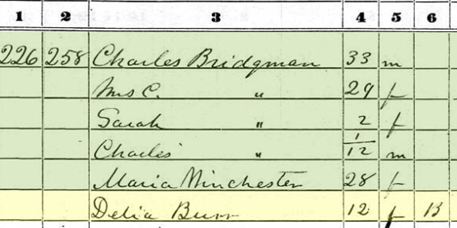
1850 US Federal Census
A Family Identified as Oneida
Delia's family history carries a documented Indigenous thread alongside its identity as a free family of color. In 1859, the Massachusetts state census of Indians, conducted by John Milton Earle and known as the "Earle Report," listed the Burr family as Oneida Indians while they were living in Holland, MA. It noted that Eli Burr's grandfather had reportedly been "an Oneida chief." Two years later, in his 1861 Report to the Governor and Council Concerning the Indians of the Commonwealth, Earle again identified members of the family — Fidelia (“Delia”) and her older sister Vianna Burr, both then residents of Springfield, as Oneida Indians.
In 1919, the Massachusetts Ways and Means Committee resolved to grant five-year annuities of $150 each to Delia (by then Mrs. Delia Daily) and her sister Samantha (Mrs. Talbot), both of Agawam, as members of the "Oneida Tribe of Indians." While the state of Massachusetts linked the Burr family to the Oneida, other records have indicated that the family was recruited or adopted by the Oneida people.
Genealogist Joseph Carvalho III, in his book Black Families in Hampden County, Massachusetts, records a family tradition that the Burrs were originally part of the Ponkapoag tribe of eastern Massachusetts and later became Oneida "by adoption." Some researchers have speculated about a possible connection between the Burr family and Seymour Burr, a Revolutionary War veteran of color who married a Ponkapoag woman, Mary Wilbur, in 1805, but no documented link between Seymour Burr and Eli Burr's line has been established by the Historical Society of Cheshire County yet.
It's also worth noting that census records did not treat the family's racial and ethnic identity consistently over time. The Burrs (and Delia herself) were recorded as "free colored," "mulatto," "American Indian," and "white" in different years. This kind of drift was not uncommon for families of mixed Black and Indigenous heritage in nineteenth-century New England. Census takers were called up on to assign a family’s race when visiting; Americans did not self-identify on census records until the mid-20th century.
Childhood and Youth (1840–1855)
Fidelia “Delia” Adelaide Burr was born in 1840 in Ludlow, MA, to Eli Burr and Saloma Brown. Her parents had married in 1832 in Ludlow and all of Delia’s siblings were born there as well: Vianna (b. 1835), Mary (b. 1838), Alonzo (b. 1843), Samantha (b. 1844), and John Albert (b. 1849).
The Burrs struggled financially as the family grew. In November 1843, when Delia was about three years old, the town of Ludlow listed Eli Burr and his children as paupers. It is possible that this poverty led Delia to live within the white household of the Bridgman family in Keene seven years later. Why Delia came to live with the Bridgmans specifically is unknown, but the pattern is a familiar one in antebellum New England. Children from poor families, especially families of color, were routinely "bound out" or placed as household servants or wards in more prosperous homes. It is plausible that Delia was placed with the Bridgmans in this way, likely in exchange for her labor and keep, with schooling as a condition of the arrangement.

1843 pauper records in Ludlow, MA— lists Burr family members, ages, place of birth, and days in need of assistance
By 1855, at the age of 17, Delia had relocated to Springfield, MA, and was boarding among many other residents alongside her older sister Mary at an establishment kept by Almira Black, possibly a hotel or boarding house.
Lovelis Wallace and the League of Gileadites
On January 29, 1862, 22-year-old Delia Burr married Lovelis (also recorded as Lovelace) Wallace, a 51-year-old farmer from Agawam, MA. This was his 3rd marriage and her first.

Wallace's own history connects Delia's family to a significant chapter of abolitionist activity in Springfield. According to historian Cliff McCarthy, Lovelis Wallace was one of twenty-seven identified members of the League of Gileadites, a mutual-defense organization founded in Springfield in January 1851 by the abolitionist John Brown, eight years before Brown's raid on the federal arsenal at Harpers Ferry.
The League, formed in direct response to the Fugitive Slave Act of 1850, was composed largely of members of Springfield's African American community and was dedicated to protecting formerly enslaved people from slave catchers. By 1850, Wallace, a widower, had recently arrived in Springfield from Maryland, and was living with Alexander and Jane Weeks, who were also League members. He had a brief marriage to Harriet Lee, a Black female lecturer and preacher, before marrying Delia in 1862.
Delia and Lovelis Wallace settled in Agawam, where they remained for at least the next eight years. By 1870, they held real estate worth $5,000 and personal property worth $1,000, and the census recorded no children in the household. Delia, in fact, appears to have remained childless throughout her life.
Possible Missionary Service in Liberia
Family historian Joseph Carvalho III notes that Delia Wallace may have traveled to Liberia as a Methodist missionary between 1884 and 1888, under the leadership of Bishop William Taylor. The Springfield Republican newspaper of the era reports on the Methodist Church’s involvement in missions throughout Africa and Asia. Many of the African Americans in Massachusetts were involved in missions to Liberia during those same years.
Widowhood, Second Marriage, and Later Life
By 1890, widow Delia Wallace was again living in Springfield with her aging parents at 46 East William Street. On January 22, 1891, she married Louis Daily, a 67-year-old Springfield "jobber" and fellow widower, twice over. This marriage appears to have lasted less than a decade: Louis Daily does not appear in any documentation connected to Delia after this point.
In the 1900 census, Delia Daily was living at 17 Lombard Street in Springfield with her 92-year-old father, Eli, and her divorced sister, Samantha Agnes Talbot. The census record notes that Delia had been married for ten years with no husband present in the household and no children.
Delia (Burr) Wallace Daily died on March 24, 1919, in Agawam (Feeding Hills), MA. Her funeral was held two days later in Springfield, and she was buried in Oak View Cemetery. Her death came just weeks after the Massachusetts legislature had approved her state annuity as a recognized member of the Oneida Tribe.
GENEALOGY
DELIA ADALAIDE BURR was born around 1840 to ELI BURR and SALOMA BROWN in Ludlow, MA. She married 1. LOVELIS WILLIAMS in Springfield, MA, on January 29, 1862. Delia married 2. LOUIS DAILY in Springfield, MA, on January 22, 1891.
SOURCE MATERIALS
Bruchac, Margaret M. "From Nonotuck to Northampton: Recovering Indigenous Histories." Historic Northampton. www.historicnorthampton.org.
Carvalho, Joseph, III. Black Families in Hampden County, Massachusetts, 1650–1865. 2nd ed. Boston: New England Historic Genealogical Society, 2011.
Jarzombek, Mark. "The Indianized Places of Massachusetts." Places Journal, February 2021. https://placesjournal.org/article/the-indianized-landscape-of-massachusetts/.
Massachusetts, Church Records. Ludlow, Massachusetts, 1831–1832.
Massachusetts State Census. 1855, 1865.
Massachusetts Vital Records. Births, 1851.
Massachusetts Vital Records. Deaths, 1866, 1882, 1893, 1900.
Massachusetts Vital Records. Marriages, 1850, 1862, 1866, 1868, 1891, 1906.
McCarthy, Cliff. "Who Were the Members of Springfield's League of Gileadites." Historical Journal of Massachusetts, Summer 2022, 175.
"Known Members of the League of Gileadites." Freedom Stories of the Pioneer Valley. https://freedomstoriespv.wordpress.com/league-of-gileadites/known-members-of-the-league-of-gileadites/.
Noon, Alfred. The History of Ludlow, Massachusetts, with Biographical Sketches of Leading Citizens, Reminiscences, Genealogies, Farm Histories, and an Account of the Centennial Celebration, June 17, 1874. Springfield Printing and Binding Company: Springfield, MA. 1912.
Rodriguez, Arlene. "John Brown." Our Plural History, Springfield, MA. [website].
Springfield City Directory. Springfield, MA, 1883, 1900.
Springfield Republican. Springfield, MA, June 14, 1890; March 14, 1919; March 27, 1919.
Town of Ludlow, Massachusetts. Pauper Records, 1843.
Town Records. Wales, Massachusetts, 1850.
U.S. Federal Census. 1830, 1840, 1850, 1860, 1870, 1880, 1900.